

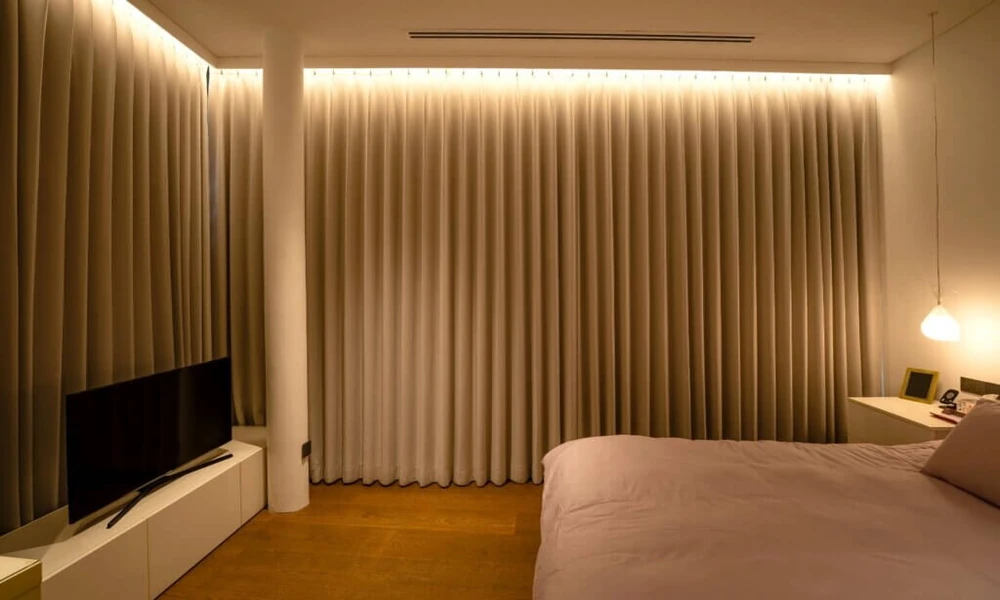
A nurse on night rota comes home at eight in the morning and needs a dark room by nine. She has already bought curtains sold as blackout, yet the bedroom still glows. Her experience is typical of anyone searching for a blackout curtain singapore suppliers describe in glowing terms: the cloth blocks light, the installation leaks it. A phone torch, a helper and ten minutes are enough to find every leak and decide what is worth fixing.
The Torch Test, Step One: Through the Cloth
Close the curtain, switch off the room light and have a helper hold a phone torch flat against the outer face of the fabric. From inside, a true blackout lining shows nothing, or at most pinpricks along stitch lines. A dim-out lining shows a soft patch of glow. Neither is faulty. They are different grades, and many curtains labelled blackout in casual speech are in fact dim-out. Knowing which you own is the starting point.
Step Two: The Halo at the Top
Now look up with the torch off and daylight outside. A bright bar above the heading means light is spilling over the track and bouncing off the ceiling. This is the commonest leak. Curtains hung from a pole on brackets stand away from the wall and suffer most. A track fixed to the ceiling, or a pelmet boxed across the top, shuts the gap. In flats with a false ceiling, a recessed curtain pocket does the same job invisibly.
Step Three: The Side Slits
Stand at the side of the window. If you can see glass between the curtain’s edge and the wall, light can see you. The remedy is width and return. The track should extend past the frame on both sides, and the last carrier should bring the fabric round to touch the wall. Where two curtains meet in the middle, they need to overlap by a hand’s breadth. A master carrier with an offset arm achieves that overlap neatly.
Step Four: The Glow Along the Floor
Kneel and check the hem. A gap of several centimetres lets a bright strip run along the tiles. Lowering the hem to just above the floor narrows it. Weight matters as well as length: a heavy, lined drape hangs straight and seals better than a light one that lifts in the fan’s draught. That same mass is what dense curtains that also dampen noise rely on, so a properly made blackout drape often brings a quieter room as a bonus.
Coated, Lined or Triple-Woven
Blackout performance comes from one of three constructions. A coated fabric has an opaque layer bonded to the back. A separate lining is sewn behind a decorative face cloth, which lets the front be any colour or texture. Triple-weave cloth sandwiches dark yarn between two outer layers and drapes softly, though it usually dims more than it blocks. Ask which construction is being quoted and, if possible, test a sample against a torch.
Colour Is Not the Deciding Factor
The nurse assumed she needed charcoal curtains. She did not. With a blackout lining the face fabric can be cream or pale grey and the room will be just as dark, because the lining does the work. Pale outward-facing linings also reflect more sun, which helps a west-facing bedroom stay cooler in the afternoon. Dark face cloths without lining, on the other hand, may look heavy yet still let a surprising amount through the weave.
What Darkness Does to Heat and Sound
Three useful side effects follow. Less sunlight through the glass means less heat for the air-conditioner to remove. Thick, pleated fabric absorbs some echo inside the room, making it feel calmer. It also takes a little off outside noise such as traffic or corridor chatter. That last effect should be kept in proportion. A curtain softens sound; it cannot seal a window, and anyone troubled by serious noise needs to look at the glazing as well.
Living With a Sealed Window in the Tropics
A tightly curtained window in a humid climate needs airing. Condensation can form on cool glass behind heavy cloth when the air-conditioner runs all night, and trapped damp encourages mould on the lining. Draw the curtains back fully for part of each day, open the window when the weather allows, and leave a slight space between fabric and glass. Removable linings or machine-washable cloths make periodic cleaning far less of a chore.
Blind Behind, Curtain in Front
For the most demanding sleepers, two layers beat one. A blackout roller blind set inside the recess handles most of the light; a lined curtain on a ceiling track in front covers the blind’s edge gaps and adds softness. In the daytime the blind can be raised and a sheer drawn instead. This arrangement costs more and needs depth in front of the window, but it is the nearest a normal bedroom gets to hotel-room darkness.
Deciding What to Order
Repeat the torch test on your own window and note which of the four leaks you have: through, over, beside or under. Then ask suppliers how their proposal closes each one, in terms of lining grade, track position, side returns and hem height. A quotation that mentions only fabric has answered a quarter of the question. Specified this way, a blackout curtain singapore fitters install will deliver the dark room that the label on the cloth merely promises.
